Find Clients
How to Build Authority on LinkedIn as a Founder (2026 Playbook)
January 28, 2025 · Bradley Jacobs

Building authority starts with your niche and pillars — get both, free, in 60 seconds:
Short answer: you build authority on LinkedIn by picking a narrow niche, choosing three or four content pillars you can talk about for years, turning your profile into a landing page, and posting consistently in your own voice. Do that for 60 to 90 days and the pattern reverses, instead of chasing clients, the right ones start coming to you. That's the whole game. The rest of this is how to actually do it.
I've posted on LinkedIn nearly every day for years, and helped thousands of founders and operators do the same. So I'll skip the motivational version and give you the mechanics: what authority actually means now, how to narrow your niche, how to pick pillars, what to post, how long it really takes, and the mistakes that keep smart people invisible.
What "authority" actually means on LinkedIn in 2026
Authority is the reputation that arrives before you do. When a founder needs what you do and a name pops into their head, or a peer tags you in a comment, that's your authority working. It is not follower count, and it is not going viral. It's whether a specific audience thinks of you first when they have the exact problem you solve.
Here's the test: if a stranger read ten of your posts, could they finish the sentence "this person is the one to call when..."? If they can't, you don't have authority yet. You have activity. The whole job is making that sentence obvious and repeatable.
This matters more for founders than for almost anyone, because you sell trust before you sell anything else. Nobody hands you their go-to-market, their round, or their pipeline on a cold pitch. They buy from the person whose thinking they already know.
How authority actually converts to inbound
Most of the people who eventually became clients or partners for me, I'd never spoken to before they reached out. But through consistent content, I'd already built a relationship with them. They felt like they knew how I think, what I value, and what I'd do in their situation.
So the sales conversation changes completely. It stops being "Hi, I'm Bradley, here's what I do" and becomes "I've been reading your posts, how soon can you start?" The trust is already there before the call begins, which means the call is about their problem, not about proving you're credible. That's the entire ROI of authority: it makes the top of your funnel warm and shortens everything after it.
Step 1: Narrow your niche until it's uncomfortable
This is foundational, and almost everyone gets it wrong by staying too broad. "Fractional CMO" is a category, not a niche. "Fractional CMO for seed-stage B2B SaaS founders who have product-market fit but no repeatable pipeline" is a niche. The second one loses you no one who would have actually hired you, and it wins you everyone who fits.
Narrow until it feels uncomfortable, then narrow once more. Three things happen when you talk to one specific person about one specific problem:
- Your content gets sharper, because you're picturing a real human instead of a market.
- The right people self-select in and the wrong ones scroll past, exactly what you want.
- Referrals get cleaner, because people can describe you in one sentence.
You can always widen later. You can't build a reputation on vagueness.
Step 2: Pick 3 to 4 content pillars from your expertise
Content pillars are the three or four themes you return to over and over, the table of contents for your expertise. Authority compounds when people can predict what you stand for before they click your profile. It never compounds if you post about leadership one day, hiring the next, and fundraising after that.
Good pillars sit where three things overlap: what you know cold, what your buyer worries about at 2am, and what you can keep talking about for a year without getting bored. A fast way to find yours:
- Write down the five questions clients ask you most. Those are your buyer-problem pillars.
- Write down the two or three opinions you hold that some peers would disagree with. Those are your point-of-view pillars, and they're what make you memorable.
- Group them. You'll usually land on three or four themes.
For a fractional CFO that might be: cash runway and forecasting, fundraising readiness, founder financial literacy, and one contrarian pillar like "most startups hire a CFO two years too late." Three that build trust, one that builds reach. The mistake to avoid is ten pillars, which is the same as having none.
The 65/25/10 content mix
Once you have pillars, the question is what ratio to post them in. A mix that works for founders:
- 65% expertise and value. The how-it-works content: frameworks, lessons, breakdowns of a problem your buyer actually has. This is the bulk of your feed and the reason people follow you.
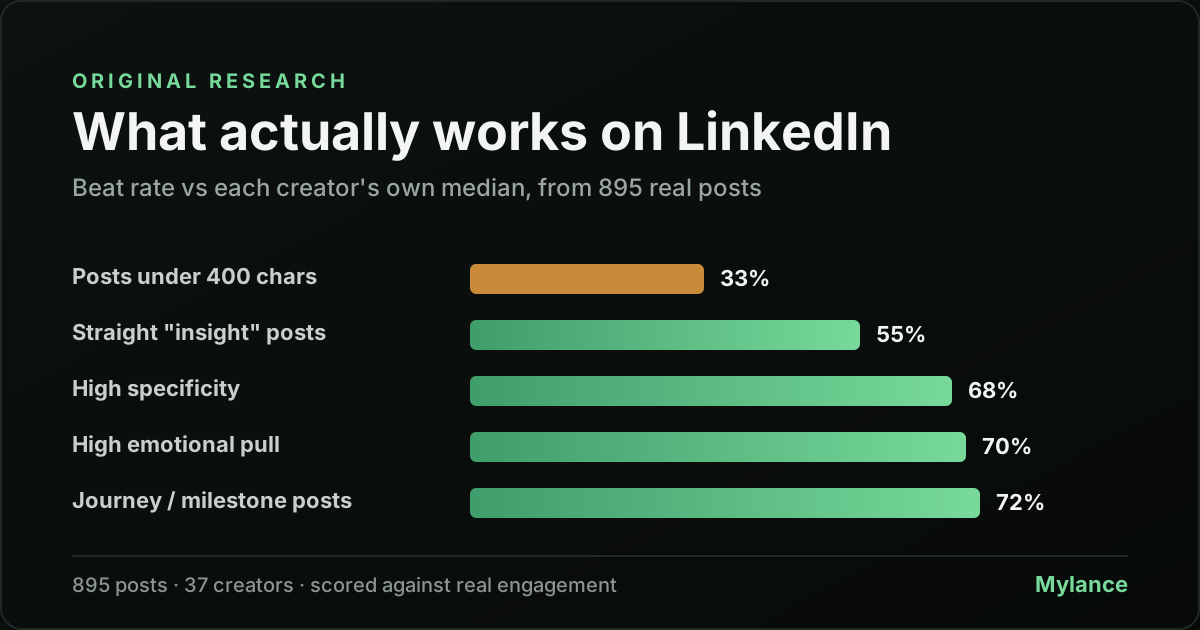
- 25% story and point of view. Your journey, a mistake you watched a company make, a contrarian take backed by experience. This is what makes you a person instead of a brand, and it's usually your highest-engagement material.
- 10% direct. The actual ask, what you do, who you help, how to work with you. You earn this small slice with the other 90%, and because you've earned it, it converts instead of repelling.
Most founders invert this: too much direct promotion, not enough value or story, and they wonder why nothing lands. Keep the promotional slice small on purpose. The business follows the trust, not the other way around.
Step 3: Turn your profile into a landing page
Every post you write sends people to one place: your profile. Treat it as a landing page, not a résumé. Someone should be able to read your headline and "about" section and immediately know who you help, what problem you solve, and why you specifically. If your headline is your job title, you're wasting your best real estate. Make it speak directly to the one person from Step 1.
This is the highest-leverage 30 minutes on this whole list, because it converts the attention your content earns. Great posts pointing at a vague profile leak trust at the exact moment someone is deciding whether to reach out.
Formats: text, carousel, and sub-90-second video
You don't need production value. You need reps. In rough order of how easy they are to start:
- Text posts. The easiest to create and to batch. Write ten in one sitting, schedule them over two weeks. Start here.
- Carousels. A simple framework or step-by-step, one idea per slide. Great for the "how you break down a problem" pillar.
- Sub-90-second video. Once you're comfortable, record yourself talking through one idea, even on a walk, on your phone. LinkedIn adds captions automatically. The authenticity of raw video often outperforms anything polished.
Pick the one you'll actually do consistently. A format you sustain beats a "better" format you abandon.
Consistency and the 60 to 90 day timeline
This is where almost everyone quits early. Consistency beats volume: two or three posts a week, every week, will out-perform a burst of daily posting followed by three silent weeks. The algorithm rewards regularity, and so does human memory, people need to see you several times before they trust you, and they can't if you keep vanishing.
Set expectations honestly. Sometimes inbound shows up in week one, because you reminded a few of the right people what you do, take those calls, but don't build your plan on them. The real compounding usually starts in months two and three. Watch for the signals, in this order: people start commenting with substance → someone says "I always see your posts" → a stranger mentions a specific post on a sales call → inbound becomes steady. Those beat vanity metrics every time.
Most of your posts will get modest engagement, and that's normal, the magic is cumulative, not per-post. The founders who treat posting as a habit rather than a campaign are the ones still doing it when it pays off.
A founder case study: 15 minutes, 700K views, 22 leads
Here's what this looks like when it works. One post I wrote, a simple story comparing Uber's and Lyft's go-to-market strategy, pulled straight from my own experience, took about 15 minutes to write. It went on to get over 700,000 impressions and generated 22 inbound leads for my consulting business.
Note what the post did not do: at no point did it pitch my services or mention that I was for hire. It just told a real story from my experience, which legitimized that experience without selling anything. That's the 65/25/10 mix in miniature, pure value and story, zero pitch, and the pipeline came anyway. The best founder content isn't researched. It's remembered.
The mistakes that keep smart founders invisible
I've watched sharp, experienced people spin their wheels for months. The traps are almost always the same:
- Being too promotional. If your content reads as bragging or constant selling, people tune out. Keep the direct slice to 10% and let value do the work.
- Inconsistency. One knowledge bomb, then three weeks of silence, kills momentum. A sustainable two-a-week beats an unsustainable daily.
- "Guru speak." Don't preach or tell people what they "should" do. Share what you actually did and learned. Write like you talk.
- Waiting until it's polished. What feels like common sense to you is often gold to someone else. The insight you'd never bother to post is frequently the one that lands. Hit publish.
Where Mylance fits
Building authority is simple to describe and hard to sustain, the failure point is almost never strategy, it's consistency and knowing what to say. That's exactly what we built Mylance to solve. It starts from your positioning, who you help and how you're different, then turns your real thinking into a repeatable content engine, so you get the compounding effect of showing up daily without it eating your week. If you want the authority without the grind of figuring out every post from scratch, that's the whole idea.
Keep reading: What a LinkedIn Ghostwriter Costs (and the Alternatives)
Mylance
Your LinkedIn should be working for you, attracting clients, building credibility, and compounding with every post. Mylance makes that happen. See how it works →
Frequently asked questions
What does it mean to build authority on LinkedIn?
It means a specific audience thinks of you first when they have the exact problem you solve. Practically: someone could read a handful of your posts and finish the sentence "this person is the one to call when...". It's reputation and trust that arrive before you do, not follower count and not going viral.
How do I build authority in a niche instead of being a generalist?
Narrow until it feels uncomfortable, then narrow once more. Pick one specific person with one specific problem and speak only to them. It feels like you're shrinking your audience, but it wins you everyone who actually fits and loses you no one who would have hired you, and it makes your content sharper and your referrals cleaner.
How often should a founder post on LinkedIn to build authority?
Two or three times a week, every week, beats a burst of daily posting followed by silence. Consistency matters more than volume because both the algorithm and human memory reward regularity. If two a week feels like a lot, commit to one thoughtful post weekly, almost nobody sustains even that, which is exactly why it works.
How long does it take to see results from LinkedIn content?
Sometimes inbound appears in the first week because you reminded your network what you do, but don't plan around that. Treat it as a long-term practice and you'll usually see more consistent results in months two and three. Watch the signals, substantive comments, "I always see your posts," a stranger citing a specific post on a call, not vanity metrics.
What should I actually post about?
Write the things you already say out loud: a client question you answered last week, a mistake you watched a company make, a number that surprised you, a common piece of advice you disagree with. The best founder content is remembered, not researched, which is why it reads as real and no one else can copy it.
Is building authority on LinkedIn different from building a company brand?
Yes. A company brand is about the offer; a personal brand is about the operator. For founders, the personal brand does the heavy lifting early because you *are* the product, people follow and refer a human more readily than a logo. Build the personal brand first; the company brand can ride on top of it once there's trust to borrow.